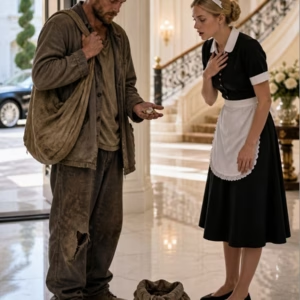
For over a decade, I worked as a caregiver at the Whitaker estate. To the outside world, I was described as “reliable, necessary, but largely invisible.” My days were built around strict routines—medication schedules, meals, cleaning, and constant supervision—designed to keep everything stable. Yet within the household, I was never truly seen as a full person. I was more of a “role, not a person,” someone expected to be present, but not acknowledged beyond their function.
Mr. Whitaker himself was difficult in the beginning. He was “Proud and resistant,” refusing help at almost every turn. Even simple tasks became daily struggles, filled with frustration and tension. Many times, leaving would have been the easier option, but I stayed. I chose patience over frustration, repeating to myself, “I stayed, choosing patience over frustration,” even when progress felt impossible.
Over the years, something slowly changed. The resistance that once defined our interactions began to fade in small, almost unnoticeable ways. There were moments of silence instead of arguments, less resistance during care, and sometimes even a quiet “thank you” that meant more than it seemed. Trust did not arrive suddenly or through emotional conversations; it developed gradually, through consistency, presence, and the steady repetition of care day after day.
By the final stage of his life, an unspoken understanding had formed between us. Words were no longer necessary to explain what had been built over years. He acknowledged, in his own quiet way, that I had stayed when I did not have to. Shortly after, he passed away.
After his death, the atmosphere of the estate changed immediately. His children returned, focused entirely on practical matters—documents, belongings, and inheritance. My years of work were quickly reduced to something administrative. My role was declared finished, my belongings were packed, and I was dismissed without recognition, left feeling “reduced to a function no longer needed.”
I tried to rebuild my life elsewhere, adjusting to a world where the years I had given seemed to disappear without acknowledgment. Then, unexpectedly, I received a call asking me to return to the estate. An envelope had been found, carefully hidden, addressed to me.
Inside was a letter and his final decision: he had left me his lakeside cabin. It was not presented as payment or compensation, but as acknowledgment. In the end, the property itself mattered less than what it represented—the quiet recognition of a life lived alongside his, and the feeling of finally being seen by someone who understood it all.