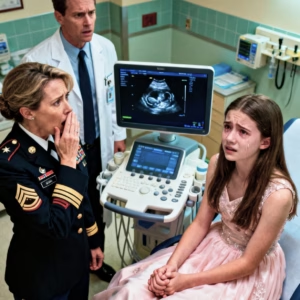
Chapter 1: The Price of Three Heartbeats
This is the chronicle of my own coup d’état. It was not fought in a boardroom or on a battlefield, but in the sterile, terrifying chill of a hospital ward, and later, across the polished mahogany of a legal table. It is the story of how the life I thought I was building was violently dismantled, only for me to forge something indestructible from the wreckage.
At 3:08 on a rain-lashed Monday afternoon, I lay paralyzed by a terror so profound it tasted metallic on my tongue. I was twenty-nine years old. My name is Hailey Finley, and I was pinned beneath the unforgiving, halcyon glare of a surgical light at St. Jude Care Center in Phoenix, Arizona.
I was only twenty-eight weeks pregnant. My body was violently convulsing, gripped by sudden, inexplicable medical complications that were tearing my world apart. For months, I had been the textbook expectant mother. I had dutifully abandoned my career early, meticulously transforming our sunny guest room into a serene, pastel-hued nursery anchoring three identical, small white cribs.
Yet, all the preparation in the world could not have readied me for the moment the fetal monitors flanking my bed began to shriek. The steady, reassuring rhythm of three tiny heartbeats suddenly fractured into a chaotic, terrifying erraticism.
Nurses swarmed the perimeter of my bed, their faces pulled tight with professional urgency. They traded clipped, clinical directives in hushed tones, adjusting IVs and repositioning sensors, while Dr. Evelyn Mercer, a woman whose usual warm demeanor had hardened into absolute steel, scrutinized the glowing monitors above me.
“Hailey, I need you to lock your eyes on mine and listen to my voice carefully,” Dr. Mercer commanded, stepping into my line of sight and gripping my trembling hand with a force that grounded me. “One baby’s heart rate is plummeting dangerously. Another is under severe distress. We have run out of time. We need to perform an emergency delivery. Right now.”
“Will my babies survive?” The words tore from my throat as a ragged whisper. I fought to draw a full breath, but the agonizing vice gripping my abdomen made it impossible.
“We are going to throw every resource this hospital has at them,” Dr. Mercer replied, her gaze unflinching, offering none of the hollow platitudes doctors sometimes use to placate the dying or the desperate. “But we cannot wait another minute.”
A desperate, primal panic surged through me. I snapped my head toward the vinyl chair stationed in the corner of the room. It was completely empty. Less than an hour ago, my husband, Porter Finley, had been sitting there. He had spent his time groaning about the stiff upholstery, endlessly scrolling on his phone, and loudly sighing every time a nurse checked my vitals. He was a senior partner at a prominent wealth management firm, a man whose entire existence revolved around the optics of success.
“I have to handle a critical portfolio issue,” Porter had announced, brushing a piece of invisible lint from his tailored trousers. “I will be back in ten minutes, I promise.” He had walked out the door without casting a single glance backward.
“Where is he?” I gasped, panic rising like bile in my throat.
Nurse Jasmine Brooks, a seasoned professional with sharp eyes and a compassionate touch, didn’t hesitate. She snatched my phone from the bedside tray and hit Porter’s contact. Her thumb hammered the screen. The first two calls went straight to a sterile voicemail greeting. On the third attempt, a connection clicked into place.
“Porter?” I cried out, a pathetic, desperate wave of relief washing over me. Thank God. He’s here. He’s coming.
But Porter didn’t answer.
Instead, the hospital room was suddenly filled with the ambient sounds of a bustling, high-end establishment. Smooth, sultry jazz music. The crystal clink of expensive glassware. A server murmuring about the daily specials. The phone had accidentally connected, the screen unlocked inside the dark cavern of his suit jacket.
“Did you really leave her all alone at the hospital?” a woman’s voice drifted through the tiny speaker. It was a soft, mocking laugh.
My blood turned to ice. I knew that laugh. It belonged to Karen Bennett, the ruthlessly ambitious executive director at Porter’s firm. I had smiled at her at countless company galas.
“Hailey turns every minor inconvenience into a catastrophic emergency,” Porter’s voice rumbled back, thick with amusement and an expensive scotch. “She probably felt one minor cramp and decided the whole universe needed to grind to a halt for her.”
I stopped breathing. The agony in my stomach was entirely eclipsed by the agonizing fault line cracking wide open straight through my chest.
“But what if those babies are actually coming right now?” Karen asked, her tone lowering conspiratorially, yet the phone’s microphone captured every treacherous syllable.
“Then the medical staff gets paid to handle it,” Porter answered smoothly, the ice in his glass clinking against the rim. “I am so utterly exhausted by her emotional manipulation. I’ll go back later tonight, stand beside the incubator, look appropriately solemn, and everyone will write me up as the devoted, tragic husband.”
“And what happens after that?” Karen purred.
“Afterward? After she inevitably breaks down under the pressure of three kids?” Porter’s voice dropped to a sinister, confident hum. “We finally start our real life together.”
Silence descended upon the delivery room, thicker and more suffocating than the humid Arizona air outside. Dr. Mercer and Nurse Jasmine had heard every single word. The man I had sworn my life to, the man whose children were currently fighting a desperate battle for survival inside my failing body, was sipping liquor with his mistress, eagerly anticipating my total collapse.
He wants me to break, I thought, a strange, terrifying calm suddenly washing over the searing pain. He is waiting for me to shatter.
“End the call right now,” I said. My voice didn’t shake. It didn’t waver. It was the voice of a ghost, cold and hollowed out.
“It’s disconnected,” Jasmine said softly, her eyes blazing with a fierce, protective anger as she tapped the red button.
I looked up at the surgeon. “Before you cut me open, Dr. Mercer, I want my husband immediately removed as my medical proxy.” I gritted my teeth as another contraction ripped through me. “I want it legally documented, right this second, that he cannot make a single medical decision for me or my children.”
Dr. Mercer nodded sharply. “We will execute the paperwork immediately.”
Within ninety seconds, a hospital administrator rushed in with a clipboard. With a hand that trembled from adrenaline, not fear, I signed away Porter Finley’s right to play God with our lives. As the anesthesia finally began to pull me down into the dark, the last thing I heard was the chaotic screech of the heart monitors flatlining.
Chapter 2: The Severed Cord
I remember almost nothing of the surgical violence that followed. My memories are fragmented snapshots: the blinding fluorescent glare of the ceiling tiles, the metallic clatter of surgical instruments, the sensation of my body being pulled and tugged in ways nature never intended.
And then, cutting through the sterile hum of the operating theater, a sound. A remarkably tiny, fragile cry.
“The first baby is out,” Dr. Mercer announced, her voice a beacon in the fog of medication. “This is Ivy. She weighs just over two pounds.”
Sixty agonizing seconds later came the second. Violet. She was even smaller than her sister, a bruised little bird, yet strong enough to let out a mewling sound that brought sudden, stinging tears to the surgical nurses’ eyes.
But for the third baby, there was only silence.
The neonatal resuscitation team swarmed the tiny warming table. For several excruciating minutes, all I heard were the rapid-fire commands of doctors fighting the reaper for my youngest child. Push one of epi. Bag her. Come on, little one, come on.
“Ivy… Violet… Hazel,” I breathed out, reciting the three names I had whispered to my swelling stomach for months, treating them as a shield against the creeping darkness. Then, exhaustion finally swallowed me whole.
When I fought my way back to consciousness the following afternoon, the harsh hospital room was softened by the late afternoon sun. Sitting vigil in the uncomfortable chair beside my bed was my cousin, Kelsey Shaw. She looked exhausted, still wearing the clothes she had thrown on before driving six hours straight from San Diego.
“They are alive, Hails,” Kelsey whispered, leaning forward and enveloping my trembling hand in hers. Her eyes were red-rimmed. “Ivy and Violet are stabilizing. They are so incredibly small, but they are fighters. Hazel…” Kelsey swallowed hard. “Hazel needs significant respiratory support. She is on a ventilator. But the doctors say she has a spark in her. She’s fighting.”
I closed my eyes, letting the tears track hot and fast into my hairline. “Has Porter been here?”
Kelsey’s expression hardened instantly, the warmth in her eyes freezing over. “No. The hospital administration called his cell phone twenty-two times. I called him five times. He finally sent me a single text message three hours ago. He claimed he was dealing with a ‘catastrophic corporate emergency’ and his phone had died.”
In that sterile room, smelling of iodine and bleached cotton, the final, pathetic illusion of my marriage evaporated. Porter hadn’t just abandoned me; he had discarded us. I was a single mother to three micro-preemies, and the war for their survival had only just begun.
Four days later, Porter finally graced St. Jude Care Center with his presence.
He did not come alone. As Kelsey pushed me down the corridor in a wheelchair toward the Neonatal Intensive Care Unit, we paused near the main administrative desk. There, standing with perfect posture, was Porter. He was accompanied by a young man carrying a massive, professional DSLR camera and a lighting rig. Porter was wearing a charcoal wool sweater, his hair meticulously tousled to give the illusion of a man who had been tearing his hair out in agonizing worry.
“I am Porter Finley. I am the father,” his voice boomed, rich with rehearsed sorrow, intended for whatever audience he planned to broadcast this to. “I need immediate access to my wife and my critically ill newborn daughters.”
The front desk nurse, having been thoroughly briefed by hospital security, typed slowly on her keyboard. “I am sorry, sir. Mrs. Finley is no longer occupying a room on the maternity ward.”
Porter’s brow furrowed in genuine confusion. He glanced back at his hired photographer, making sure the lens was capturing his ‘distress.’ “Was she moved to a private VIP suite? Take me there.”
“She has been legally flagged as confidential, sir,” the nurse replied, her voice an immovable wall.
“What in the hell does that mean?” Porter’s mask slipped, exposing a flash of the arrogant tyrant beneath. “Where are my children? I demand you tell me where they are!”
“Their medical location and status are restricted under a protective order,” a stern hospital administrator declared, stepping out from a glass-walled office.
“You cannot do this! I am their legal father. I know the CEO of this hospital system!” Porter spat, his face flushing dark red.
“You were contacted repeatedly during a life-or-death emergency and willfully refused to respond,” the administrator countered, his tone dropping to a lethal calm. “Mrs. Finley executed official documentation prior to surgery, revoking your proxy. Furthermore, the hospital has internal incident reports regarding your… unavailability. We are not granting you access.”
“Stop recording! Put the damn camera down!” Porter suddenly snarled at his photographer, violently shoving the camera lens toward the floor.
He didn’t leave the building with the heroic, tear-stained PR photos he had orchestrated for his LinkedIn and social circles. Instead, hospital security escorted him to the sliding glass doors, where a process server handed him a thick stack of emergency restraining orders and custody injunctions.
As I watched him storm into the parking lot from my wheelchair, I felt a fleeting surge of triumph. But as he turned back to glare at the hospital building, his eyes dark with vindictive rage, I knew the truth.
This wasn’t over. A narcissist backed into a corner doesn’t surrender; they plot.
Chapter 3: The Charade Unravels
For the next six months, the NICU became my entire universe. I moved into Kelsey’s guest room in the suburbs, spending fourteen hours a day beside three clear, plastic incubators. I lived on stale cafeteria coffee and the rhythmic, terrifying beeping of heart monitors. I read The Velveteen Rabbit to babies whose hands were smaller than my thumbnails.
While I was fighting for my daughters’ lungs to expand, Porter was busy fighting a public relations war.
He hired one of the most vicious, astronomically expensive family law firms in the state. He launched a sophisticated smear campaign on social media, painting himself as the tragic, alienated father. He claimed I suffered from severe postpartum psychosis. He told mutual friends that I had hallucinated his negligence, that he had been securing our financial future while I suffered a mental break.
“Do not engage with him online. Do not defend yourself in the comments,” my attorney, Zachary Sloan, instructed me during a somber meeting in his downtown office. Zachary was a bulldog of a lawyer, a man who dealt in facts, not emotions. “Let him build his public altar of lies. Men who worship their own reflections always shatter the mirror eventually.”
Six months after the emergency delivery, the court mandated an absolute settlement conference to determine temporary custody and financial support while the divorce proceeded.
I sat rigidly at the polished oak table in Zachary’s conference room. The air was thick with tension. Across from me sat Porter, wearing a bespoke navy suit that probably cost more than the NICU bills for that week. He looked relaxed, supremely confident, leaning back in his leather chair while his silver-haired attorney prepared to dismantle me.
“My client is a pillar of the financial community, a man of impeccable standing,” Porter’s attorney began, his voice dripping with condescension. “We are prepared to offer Mrs. Finley a generous psychiatric stipend, provided she surrenders primary custody of the children to a stable environment—namely, Mr. Finley’s estate.”
I gripped the edge of the table so hard my knuckles turned white. He wants to take them from me. He wants them as accessories.
Before Zachary could unleash his rebuttal, the heavy oak door of the conference room clicked open.
Everyone turned. Standing in the doorway, looking pale, hollowed out, and devoid of her usual corporate armor, was Karen Bennett. She was flanked by a severe-looking corporate litigator.
Porter bolted upright, his chair skidding backward against the carpet. “Karen? What in God’s name are you doing here?”
“I am here because you threw me to the wolves, Porter,” Karen said, her voice shaking with a potent mixture of rage and sheer terror. She walked to the center of the table and dropped a heavy, sealed manila envelope onto the wood. “You told the board of directors that the embezzlement was entirely my operation. You claimed I acted without your oversight to save your own skin when the auditors showed up last week.”
“Karen, shut your mouth right now. Think very, very carefully about the NDAs you signed,” Porter hissed, stepping around the table, his fists clenched.
“I don’t care about the NDAs anymore,” Karen fired back, tears of bitter betrayal brimming in her eyes. “You think you’re the only one who takes precautions? The company issues luxury vehicles to senior partners, Porter. You know this. What you apparently forgot is that the security suites in those cars record internal cabin audio to the corporate cloud in the event of an accident or emergency trigger.”
She reached into her blazer, pulled out a small, silver flash drive, and slid it across the table toward my attorney, Zachary.
“The emergency system triggered a recording when the hospital called his car’s Bluetooth system,” Karen whispered, looking directly at me for the first time. The guilt in her eyes was palpable. “I’m sorry, Hailey.”
Zachary smoothly picked up the drive, plugged it into the conference room laptop, and hit play.
The audio filled the room. It was crystal clear. It wasn’t the muffled version I had heard over a hot microphone in a restaurant; it was the high-definition dashcam audio of Porter sitting in his running Mercedes outside the restaurant, right after I had been wheeled into surgery.
“Mr. Finley, your wife is hemorrhaging. The babies are in critical distress, you need to return immediately!” a nurse’s voice pleaded from the car speakers.
“Tell her I’m stuck in gridlock,” Porter’s voice echoed through the boardroom, cold, calculating, and dripping with annoyance. “I am not going back to that circus yet. She always finds a way to make everything about her. Let the doctors deal with the mess.”
The recording clicked off.
The silence that followed was absolute, heavy enough to crush bone.
Porter’s high-priced attorney slowly, methodically closed his leather-bound legal pad. He didn’t look at Porter. He didn’t look at me. He just stared at the blank wall.
“Mr. Finley,” his lawyer finally spoke, his voice utterly devoid of its previous bluster. “I am ethically bound to inform you that I can no longer continue representing you in this matter. We are adjourned.”
I looked across the table at Porter. The slick, untouchable titan of industry was gone. In his place stood a terrified, ruined man, trapped in the inescapable prison of his own supreme arrogance. The facade had cracked, and the world was finally seeing the monster I had married.
But as I drove back to the hospital that afternoon, clutching the temporary full-custody order Zachary had expedited, my phone rang. It was Dr. Mercer.
“Hailey,” she said, her voice lacking its usual steady cadence. “You need to come to the pediatric oncology wing immediately. It’s Hazel.”
Chapter 4: The Devil’s Bargain
The utter destruction of Porter Finley in the divorce courts brought a temporary peace to our lives. With full legal and physical custody secured, and Porter ousted from his firm under the dark cloud of a federal financial investigation, I finally breathed.
For nearly a year, I built a sanctuary for my girls. Ivy blossomed into a fiercely independent toddler who loved to climb furniture. Violet was the soul of gentleness, fascinated by the texture of leaves and the family dog. And Hazel… Hazel was my little fighter. She was physically smaller than her sisters, her milestones delayed, but she possessed a blindingly bright smile that could illuminate the darkest room.
Then, the bruising started.
First, it was a dark purple smudge on her shin that wouldn’t fade. Then, profound lethargy. A persistent, low-grade fever that Tylenol couldn’t touch.
The blood panels at St. Jude confirmed my absolute worst nightmare. Hazel’s bone marrow was failing. It was a rare, aggressive aplastic disorder. Her tiny body had simply stopped producing the cells she needed to survive.
“She needs a hematopoietic stem cell transplant, Hailey,” Dr. Mercer told me softly, sitting in the dimly lit consultation room. “A bone marrow donor. It is her only viable option for long-term survival.”
I was tested immediately. I was not a match. Kelsey was tested. Not a match. We scoured the national and international registries. Weeks bled into a month of agonizing false hope. Hazel grew weaker, her skin taking on a translucent, fragile pallor.
“There is one other immediate biological option,” Dr. Mercer had said, her eyes filled with deep sympathy. “Her father.”
Through Zachary, a court order was issued compelling Porter to submit a DNA swab. Three agonizing days later, the results returned.
Porter Finley was a perfect 10/10 biological match.
Two nights later, a heavy, authoritative knock rattled the front door of Kelsey’s house. I opened it to find Porter standing on the porch. He looked different—thinner, his eyes hardened into cold, reptilian slits. He carried a thick, leather-bound folio.
He didn’t ask how Hazel was. He didn’t ask to see his daughters. He walked past me into the living room and tossed the folio onto the coffee table.
“I have spoken to my medical team. I will undergo the bone marrow extraction,” Porter stated, his voice devoid of any human warmth. “I will save her life. But only after you sign this.”
“What is this?” I asked, my heart hammering a frantic rhythm against my ribs as I stared at the legal documents.
“It is a full, irrevocable legal agreement,” Porter explained, settling onto the sofa as if he still owned me. “First, you will issue a sworn, public statement retracting your allegations of abandonment. You will state that you suffered a postpartum breakdown and misinterpreted my actions. Second, you will grant me immediate, 50/50 joint physical and legal custody of all three girls.”
A sickening wave of nausea washed over me. The room began to spin. He is holding his own daughter’s life hostage.
“You are leveraging your dying child’s marrow for a PR stunt and control?” I breathed, staring at him as if he were an alien species.
“I am reclaiming the life and the reputation you stole from me,” Porter replied, adjusting his cuffs. “I lost my firm. I lost my standing. You did that. Now, you will undo it. You sign the papers, I go to the hospital, and Hazel lives. You refuse, and I walk out that door, and you can explain to Ivy and Violet why their sister is gone.”
“You did this to yourself,” I hissed, venom lacing my words. “You abandoned us!”
“Tick tock, Hailey,” Porter sneered, standing up. “You have until 8:00 PM tomorrow. Have Zachary notarize it and send it to my new counsel. If I don’t have it by 8:01, the offer is permanently rescinded.”
When the door clicked shut behind him, I collapsed onto the floor, my hands tearing at my hair. I was trapped in a nightmare with no waking up. If I refused, I was signing Hazel’s death warrant. If I agreed, I was feeding all three of my daughters back to the wolf, subjecting them to a lifetime of his narcissistic, psychological abuse.
The next evening, at 7:45 PM, I sat at the dining room table. The contract lay before me, mocking me. Hazel was asleep in the next room, her breathing shallow and ragged.
I picked up the pen. My hand shook so violently I could barely grip the plastic. I lowered the nib toward the signature line, a single, devastating tear falling onto the thick parchment paper, smudging the ink of my own surrender.
Just as the metal tip scratched against the paper, my cell phone, sitting next to the contract, erupted with a piercing ring.
It was Dr. Mercer.
Chapter 5: The Final Judgment
“Hailey, put the pen down. Do not sign a single page of that monster’s contract!” Dr. Mercer’s voice was breathless, practically shouting through the phone’s speaker.
I froze, the pen hovering a millimeter above my printed name. “Evelyn… what’s happening? Time is up. I have to save her.”
“We found a match,” Dr. Mercer cried, a sound that was half-laugh, half-sob. “The international registry just updated an hour ago. A twenty-six-year-old primary school teacher in the Netherlands. She is an 11/11 high-resolution allele match. She is a better biological match than Porter. We contacted her European coordinator fifteen minutes ago. She has already unequivocally agreed to the donation and is being prepped for the extraction protocol in Amsterdam tonight!”
The pen slipped from my numb fingers, clattering loudly onto the hardwood floor. I couldn’t speak. I simply fell forward onto the dining table, burying my face in my arms, and let loose a wail of absolute, transcendent relief that seemed to empty my soul of a year’s worth of poison.
The following morning at 9:00 AM sharp, Zachary Sloan did not email a signed contract to Porter’s lawyer. Instead, he marched straight into the chambers of the presiding family court judge, carrying Porter’s unsigned extortion demand.
“Your Honor,” Zachary boomed, slamming the folio onto the judge’s bench. “Attempting to coerce a mother into surrendering fundamental parental rights, and demanding she perjure herself publicly, in direct exchange for a life-saving biological donation to a minor child, is not merely unethical. It borders on criminal extortion.”
The judge, a formidable woman who had presided over thousands of ugly divorces, read the contract. I watched the color drain from her face, replaced by a dark, terrifying fury.
Porter, who had been summoned to the courthouse expecting a surrender, sat at the defendant’s table looking utterly bewildered.
“Mr. Finley,” the judge said, her voice deadly quiet, echoing through the cavernous courtroom. “In my twenty years on this bench, I have seen the darkest corners of human depravity. But wielding your own child’s mortality as a bargaining chip for a public relations rehabilitation… that is a special breed of evil.”
She didn’t just reject his contract. She weaponized it against him. The judge issued a permanent, irrevocable order stripping Porter of any remaining supervised visitation rights. He was legally barred from coming within five hundred feet of my daughters until they reached the age of majority.
He was destroyed by the very trap he had built for me.
Epilogue: A Flagstaff Sunrise
Hazel received her transplant from the Dutch teacher three weeks later. The healthy stem cells took root in her marrow, a miraculous alien garden blooming inside her tiny bones. Within months, the color returned to her cheeks. Within a year, she was running.
Four years have passed since that terrifying afternoon in the hospital.
I am thirty-three now. We left the suffocating heat of Phoenix behind and bought a rambling, wood-paneled house in Flagstaff, surrounded by whispering ponderosa pines.
I am standing on the back porch right now, wrapping my hands around a warm mug of black coffee. The crisp mountain air fills my lungs. Out on the expansive green lawn, the triplets are a whirlwind of joyful chaos. Ivy is wearing a ragged superhero cape, directing an imaginary battle. Violet is meticulously arranging fallen pinecones into intricate geometric patterns on the patio. And Hazel—my fiercely brave Hazel—is sprinting across the grass, shrieking with laughter as she chases iridescent soap bubbles into the wind, her legs strong, her lungs full, her life entirely her own.
I look at them, and I know that I won the only war that ever mattered. True power doesn’t come from corner offices, luxury cars, or the ability to bend others to your will through fear. True power—the kind of strength that can shatter diamonds—comes from standing directly in front of the people you love when the darkness comes, and refusing to move. I survived the coup d’état, and from the ashes of a broken marriage, I built a kingdom of light for my girls.
If you want more stories like this, or if you’d like to share your thoughts about what you would have done in my situation, I’d love to hear from you. Your perspective helps these stories reach more people, so don’t be shy about commenting or sharing.