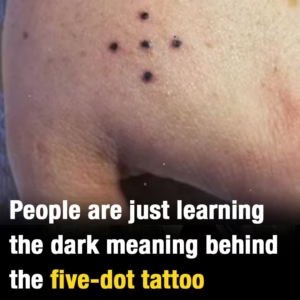
You notice a small bump on your hand.
At first, it seems harmless.
Maybe it’s rough to the touch. Maybe it hurts slightly when pressed. Perhaps it appeared so gradually that you barely paid attention to it.
Weeks pass.
Then months.
The bump gets larger.
Or another one appears nearby.
Before long, you’re searching online, wondering whether it’s dangerous, contagious, or something that requires medical attention.
The truth is that millions of people develop warts every year, yet many know surprisingly little about them. Some ignore them completely. Others attempt treatments that make the problem worse. And many fail to realize that not all warts are the same.
Understanding the different types of warts, how they spread, and the best ways to treat them can help prevent unnecessary discomfort and reduce the risk of spreading them to others.
At their core, warts are small skin growths caused by certain strains of the human papillomavirus, commonly known as HPV.
When the virus enters the body through tiny cuts, scratches, or breaks in the skin, it can trigger rapid growth of skin cells. The result is the raised, rough texture that many people recognize as a wart.
Although they can look alarming, most warts are harmless.
However, they can be annoying, uncomfortable, and sometimes difficult to eliminate once established.
One reason warts cause so much confusion is that they come in several different forms.
Each type has its own appearance, preferred location, and treatment considerations.
The most common variety is appropriately called the common wart.
These usually appear on the hands and fingers. Their rough, uneven surface often resembles a tiny cauliflower. While they may begin as small bumps, they can gradually increase in size if left untreated.
Because hands frequently come into contact with shared surfaces, common warts are among the easiest types to spread.
Another frequently encountered variety is the plantar wart.
Unlike common warts, plantar warts develop on the soles of the feet. Constant pressure from walking forces them inward rather than outward.
As a result, many people mistake them for calluses or small stones trapped inside their shoes.
Plantar warts can become surprisingly painful, especially when walking or standing for extended periods.
Flat warts represent another category entirely.
As their name suggests, they sit flatter against the skin and have a smoother appearance than most other warts.
These often develop on the face, arms, or legs.
Because facial skin tends to be more sensitive, treatment options may require additional care and professional guidance.
Then there are filiform warts.
These are among the most distinctive-looking varieties.
Instead of appearing as rounded bumps, they often develop as long, narrow growths resembling tiny threads extending from the skin.
They frequently appear around the eyes, nose, and mouth.
Their unusual appearance can make them particularly concerning for patients, although they are generally no more dangerous than other wart types.
Genital warts require special attention because they are associated with sexually transmitted HPV infections.
They may appear on or around the genital area and can vary significantly in size and appearance.
Some remain small and flat.
Others grow larger and cluster together.
While certain HPV strains responsible for genital warts are considered lower risk, other strains have been associated with increased risks of specific cancers.
For this reason, prevention, regular medical care, and appropriate screening remain extremely important.
Another growth often confused with traditional warts is the age wart, sometimes called a seborrheic keratosis.
These growths commonly appear later in life and can range in color from light tan to dark brown.
Although they are usually harmless, they can sometimes resemble more serious skin conditions.
Any new skin growth that changes rapidly, bleeds, or appears unusual should be evaluated by a healthcare professional.
One of the most common questions people ask is whether warts are contagious.
The answer is yes.
But perhaps not in the way many people imagine.
Warts do not spread as easily as the common cold.
Instead, transmission generally occurs through direct skin contact or exposure to contaminated surfaces.
Shared razors.
Locker room floors.
Public showers.
Towels.
These environments can sometimes facilitate transmission, particularly when skin is damaged or vulnerable.
Fortunately, there are several approaches available for treatment.
Many warts eventually disappear without intervention as the immune system gradually clears the infection.
Unfortunately, this process can take months or even years.
As a result, many people seek faster solutions.
One of the most famous home remedies involves duct tape.
While it may sound unusual, some people report success by keeping a wart covered continuously for several days before gently removing dead tissue.
Researchers have produced mixed results regarding its effectiveness, but the method remains popular due to its simplicity and low cost.
Apple cider vinegar is another commonly discussed option.
Because of its acidity, some people use diluted solutions as a home treatment.
However, caution is important.
Undiluted vinegar can irritate healthy skin and potentially cause burns.
Tea tree oil is frequently mentioned as well due to its antimicrobial properties.
When properly diluted with a carrier oil, some individuals find it helpful as part of a broader treatment strategy.
Salicylic acid remains one of the most widely recommended over-the-counter treatments.
Found in various wart removal products, it works by gradually peeling away infected skin.
Consistent application over time often produces favorable results.
Still, not every wart should be treated at home.
Warts located on the face, around the eyes, in the genital area, or those that become painful, bleed, or change appearance deserve professional evaluation.
Dermatologists have access to additional treatment options, including cryotherapy, prescription medications, laser procedures, and minor surgical removal.
The most important lesson is simple.
Do not ignore persistent skin changes.
Most warts are harmless.
But understanding what you’re dealing with allows you to make informed decisions about treatment and prevention.
A tiny bump today may seem insignificant.
Yet knowing the difference between a common wart, a plantar wart, a harmless age-related growth, or something more serious can provide valuable peace of mind.
When it comes to skin health, paying attention early is often the easiest path toward successful treatment and prevention.