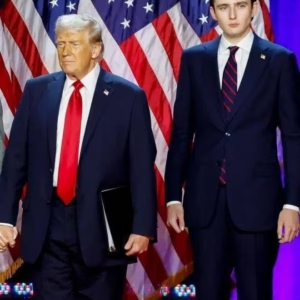
Donald Trump falls on the stairs while boarding Air Force One!

In the hyper-accelerated reality of the 21st-century digital age, the boundary between a private moment and an international headline has narrowed to the size of a smartphone screen. For global leaders—whose every movement is filmed, stored, replayed, and scrutinized by an ever-present wall of cameras—the notion of a “small incident” has effectively disappeared. A recent example of this phenomenon emerged when President Donald Trump briefly lost his footing while climbing the stairs to Air Force One. Though physically insignificant, the moment became a digital flashpoint, revealing how modern political culture, algorithm-driven media, and public expectations intersect to elevate an ordinary stumble into a subject of national debate.

The incident occurred during a routine travel stop in Morristown, New Jersey. After finishing a short interaction with reporters, Trump turned toward the aircraft and began ascending the metal staircase. In a fraction of a second, captured by news cameras, his foot appeared to catch, prompting a brief, reflexive shift in balance—the kind of correction countless people make every day on slick sidewalks or uneven ground. Notably, Secretary of State Marco Rubio, who was nearby, seemed to experience a similar momentary instability on the same stairs. Neither man fell, neither needed help, and the ascent continued uninterrupted. Within moments, the aircraft doors closed. In any previous era, the episode would have passed unnoticed. In 2025, it marked the beginning of a viral storm.

The speed at which the footage spread was driven by the built-in incentives of modern social platforms. TikTok, X, and Instagram favor short, visually striking clips that demand little context while triggering immediate emotional reactions. A stumble involving a polarizing political figure is ideal algorithmic material—easily replayed, endlessly remixed, and perfectly suited for interpretation through personal bias. This “clip culture” strips away situational context, such as wind on an open tarmac or the steep angle of industrial aircraft stairs, in favor of narratives centered on weakness, symbolism, or humor.

Fueling the intensity of the response is the ongoing national conversation surrounding the age and physical endurance of political leaders. As presidents have grown older on average, public attention has increasingly fixated on appearances of vigor. Every step, wave, and climb is treated less as a routine motion and more as an informal health assessment. In this environment, a single misstep is rarely accepted as a common human moment; instead, it is framed as a symbolic fracture in perceived leadership strength. The Trump video thus became a vessel for broader anxieties about aging and executive power already simmering beneath the surface.

Media coverage further complicated public interpretation. In today’s fragmented information landscape, neutrality is often perceived through partisan lenses. Many observers quickly compared the moment to President Joe Biden’s 2021 stumble on the same aircraft stairs. Trump supporters argued that his incident was being minimized compared to the prolonged scrutiny Biden faced, while critics insisted the opposite was true. This cycle of “comparative outrage” highlights a deep erosion of trust in consistent journalism. Increasingly, news events are evaluated not on their factual weight, but on how they align with individual perceptions of media bias.

From a psychological standpoint, the viral spread of the clip is a textbook example of confirmation bias. Those predisposed to question a leader’s fitness interpret the stumble as validation, while supporters dismiss it as an exaggerated non-issue amplified by hostile coverage. This split ensures that even the most neutral footage becomes politically charged. The stumble itself fades into the background, replaced by arguments about what the stumble supposedly represents, diverting attention away from policy and governance toward performative optics.

Historically, presidential physical limitations were often concealed from public view. Franklin D. Roosevelt’s wheelchair was rarely photographed, John F. Kennedy’s chronic illnesses were closely guarded secrets, and early signs of Ronald Reagan’s cognitive decline were carefully managed behind closed doors. Today, such protective barriers no longer exist. We live in an era of constant exposure, where demands for transparency collide with a digital ecosystem that rewards sensational moments. Leaders are now forced into an exhausting performance of visible strength, where even a brief loss of balance can be reframed as political ammunition.

Physical imagery has always played a role in political storytelling—from Theodore Roosevelt’s rugged “Rough Rider” image to modern campaign visuals of candidates jogging or boarding planes with energetic strides. These scenes are crafted to signal endurance and capability. When footage like the Air Force One stumble disrupts that narrative, campaigns must respond carefully—often by downplaying the incident, using humor, or redirecting attention—while opponents work to keep the clip circulating as long as possible.

The power of social media algorithms amplifies this dynamic even further. Designed to promote content that sparks strong emotional reactions such as amusement or outrage, these systems prioritize visually simple moments over complex policy discussions. A stumble is instantly understood and emotionally charged, making it far more algorithmically valuable than a detailed speech on governance. Over time, this creates a feedback loop in which trivial physical moments are elevated as defining indicators of leadership, overshadowing substantive issues.

In practical terms, the stairway stumble was nothing more than a minor physical interruption during a demanding travel schedule. It caused no injury, no disruption, and no change in official duties. Yet as the video coursed through the digital bloodstream, it accumulated symbolic meaning, tapping into deep political sensitivities—ageism, partisan loyalty, distrust of media, and the culture of viral outrage. Ultimately, it served less as a story about balance and more as a mirror reflecting what audiences were already inclined to believe.

Soon enough, this particular moment will fade, replaced by the next viral clip of another leader’s fleeting mistake. But the forces it exposed—the fragmentation of truth, the emotional logic of algorithms, and the relentless pressure of public visibility—will persist. The incident was never truly about a foot catching on a metal step; it was about a society struggling to maintain its own balance in a world where everything is recorded, nothing disappears, and even the smallest misstep can be transformed into a national spectacle.

Related Posts

We Opened a Christmas Invoice—Then Everything Shifted

For eight straight years, Christmas lived at my house. Same decorations, same routines, same unspoken expectation that I would host—plan, cook, clean, and hold everything together. No…

Seven Lives Lost in North Carolina Plane Accident, Including Former NASCAR Driver Greg Biffle and Family!

The morning of December 18, 2025, began like any other winter Thursday in North Carolina, with a quiet drizzle and a low, gray ceiling of clouds clinging…

America Mourns as 4 National Icons Passed Away Within Hours, The Loss of These Legends Has Left a Country in Total Shock!

In the tapestry of American history, there are dates that stand out not for a single event, but for a strange, almost celestial alignment of loss. As…

Michael Jackson’s daughter has broken her silence: “My dad used to…See more👇

Michael Jackson’s childhood was shaped by extraordinary talent and intense discipline. Growing up in Gary, Indiana, he and his siblings were trained rigorously by their father, Joseph…

✨📷 When Beauty Meant Restraint — Freckle Removal in the 1930s Hungary, 1937. A woman lies motionless inside a bright white cl!nic, her he’ad locked in a…Check the first comment 👇

When Beauty Meant Restraint — Freckle Removal in the 1930sHungary, 1937.A woman lies motionless inside a bright white clinic, her head locked in a metal frame, a…

Tim McGraw shares heartbreaking family moment for him and … See more…

Country music legend Tim McGraw moved fans to tears today as he shared a deeply personal and heartbreaking family moment. The 56-year-old superstar posted a vulnerable tribute…

Leave a Reply

Your email address will not be published. Required fields are marked *