In the collective memory of the rock-and-roll era, there are tragedies that transcend the headlines to become part of a shared cultural mourning. For Eric Clapton, now 79, that defining moment occurred on a gray Manhattan morning in 1991. While millions are familiar with the haunting chords of the anthem that grew out of his sorrow, few truly grasp the excruciating “near-misses” and the final, unspoken vows that preceded the fall of four-year-old Conor Clapton.
As a journalist who has covered the intersection of celebrity and human tragedy for over a decade, one finds that the most staggering details are often found in the quiet moments right before the world breaks. For the man known as “Slowhand,” the tragedy wasn’t just the loss of a child; it was the loss of a newly discovered version of himself.
The Fax Machine and the Fraction of a Minute
The events of March 20, 1991, read like a cruel script of missed opportunities. Conor was in New York with his mother, the Italian actress Lory Del Santo, staying in a 53rd-floor apartment in a luxury Manhattan high-rise. The morning was routine until a housekeeper, having finished cleaning a floor-to-ceiling window, left the glass unlatched.
In the high-energy burst of a child anticipating a day of fun, Conor ran past the open portal. Del Santo, distracted for a heartbeat by the mechanical chirp of a fax machine, stepped away to check the incoming message.
“I heard the fax machine and checked it out before going to check on Conor,” Del Santo later recalled, her voice still heavy with the “what-ifs” that haunt survivors. “I walked in just a fraction of a minute too late. He had gone. If I hadn’t checked the fax, he’d still be alive.”
Clapton, who was staying at a nearby hotel, was already on his way to the apartment to collect his son for a planned outing to the Bronx Zoo. When the news finally reached him, the man who had survived the excesses of the 1970s and 80s went into a state of psychological stasis. “When I told Eric what had happened, he froze solid,” Del Santo said. “It was like he’d just stopped functioning. He didn’t say anything. It was all so unreal.”
The Circus Vow: A Father Reborn
The true tragedy of Conor’s death lies in the timing of Clapton’s personal redemption. Though he and Del Santo were no longer a couple, they had reunited in New York to spend Easter as a family. On March 19, the day before the accident, Clapton had taken Conor to the circus on Long Island.
It was a milestone. For the first time, the rock legend was alone with his son for an entire day, without nannies or assistants. In the sawdust-scented air of the big top, surrounded by clowns and elephants, the distant rock star finally felt the pull of domesticity. Biographer Philip Norman, in Slowhand: The Life and Music of Eric Clapton, notes that this afternoon was a revelation for the musician.
Returning to the apartment with a chattering, excited toddler, Clapton turned to Del Santo and made a monumental promise: he was finished with being a part-time parent. He intended to be a “proper father.” He spoke of moving the family to London. He promised Conor a trip to the zoo the very next day, followed by a celebratory lunch at a local Italian restaurant. He had finally decided to show up for his life, only to have the focal point of that life vanished less than twenty-four hours later.
Isolation in Antigua: Healing Through the Strings
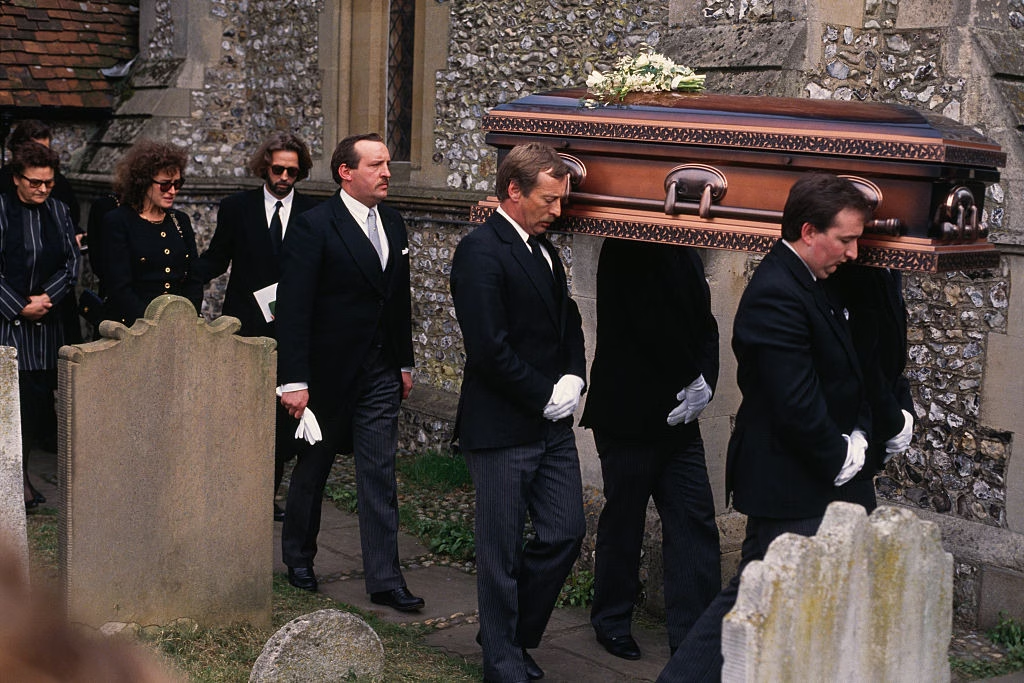
Following a somber funeral in Clapton’s hometown of Ripley, Surrey—a village 25 miles southwest of London that served as his childhood sanctuary—the musician did what he has always done when the world becomes unbearable: he retreated into the music.
Overwhelmed by a grief that made public life impossible, Clapton fled to the Caribbean island of Antigua. He spent nearly a year in total isolation in a small rented cottage, shunning the outside world to “swat mosquitoes” and grapple with his Spanish string guitar.
“All I could do was play and write these songs,” Clapton recalled of that period of hermetic mourning. “I re-wrote and re-performed them again and again and again until I felt like I had made some sort of move towards the surface of my being.” This painstaking process of melodic exorcism eventually birthed “Tears in Heaven,” co-written with Will Jennings. The song would eventually sweep the Grammys and touch millions, but for Clapton, it was a private bridge back to the land of the living.
The Final Blow: A Postmarked Ghost
Perhaps the most devastating detail of the entire ordeal occurred after the funeral. While sorting through the mail at his London home, Clapton found a regular envelope that had been posted from New York just days before the accident.
Inside was the first letter Conor had ever written. With the help of his mother, the four-year-old had carefully practiced his letters to send a message to his “Papa.”
“The baby had learned to write a few words,” Del Santo remembered. “He said to me, ‘Oh mummy, I want to write a letter to daddy, what shall I write?’ I told him, ‘Well, write, I love you.’ He wrote that and we posted it.”
Clapton opened the letter only after the boy who wrote it was buried. It was a physical remnant of the “I love you” that should have been spoken over lunch at an Italian restaurant or among the enclosures of the Bronx Zoo. It remains a staggering reminder that for Eric Clapton, the greatest hit of his career was paid for with a price no father should ever have to calculate.