While rock, paper, scissors is usually seen as a game of luck, a scientist has revealed what they claim is a surefire way to beat your friends.
According to Dr Denise Moerel, a cognitive scientist at Western Sydney University in Australia, the trick is to forget about the previous round.
In a piece for The Conversation, Dr Moerel explains that thinking too hard about what’s just happened can stop you from being ‘truly random’.
In experiments, ‘random and unpredictable’ players who didn’t take notice of past choices – either theirs or their opponent’s – tended to be victorious.
According to Dr Moerel, there’s a lot we can learn from the simple game, which has Chinese roots dating back around 2,000 years.
‘There’s an optimal strategy for winning multiple rounds of rock, paper, scissors – be as random and unpredictable as possible,’ she said.
‘Don’t pay attention to what happened in the last round.
‘When trying to be unpredictable, it’s not helpful to rely on past outcomes.’
For their study, Dr Moerel and her colleagues recruited 62 participants (31 pairs) who played a computerized version of rock, paper, scissors.
In all, 15,000 rounds of the game were played while participants had their brain activity recorded by electroencephalography (EEG) – a method involving a mesh of electrodes placed along the scalp.
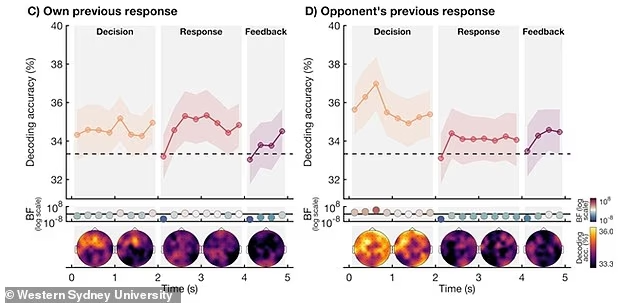
According to Dr Moerel, patterns in brain activity picked up by EEG helped the experts predict what shape a player would draw next.
Remarkably, the live brain scanning data could also instantly reveal whether or not a player was still thinking about the previous game.
‘We could predict a player’s decision about whether to choose “rock”, “paper”, or “scissors” from their brain data even before they had made their response,’ Dr Moerel said.
‘This means we could track decision-making in the brain, as it unfolds in real time.’
According to the results, people who were thinking about the moves from previous rounds tended to lose more often than those who were not.
In other words, a player might negatively affect their chances if they’re thinking something along the lines of, ‘OK, she did rock twice in a row so she’ll probably do paper or scissors next’.
In experiments, ‘random and unpredictable’ players who didn’t take notice of past choices – either theirs or their opponent’s – tended to be victorious
Instead, the better strategy is to keep your mind clear and make your next shape as totally random as possible, the findings suggest.
The problem with letting past rounds inform your decisions is that your opponent knows what they were too – so you become predictable.
In the experiments, only the brains of participants who lost the game had information about the previous game, while the brains of the winners did not.
The experiments also found most people had a clear bias where they overplayed one of the options, preventing them from being truly random and thus negatively affecting their chances.
Interestingly, more than half of the players favoured ‘rock’ followed by ‘paper’, while ‘scissors’ was favoured least.
Rock may be favoured due to unconscious perceptions of it being strongest despite all three shapes being mathematically equal.
In addition, people tended to avoid repeating choices – meaning they usually went for a different option on their next round.
This happened ‘more often than would be expected by chance’, again suggesting the human brain is influenced by the preceding round.
Overall, the results show humans ‘struggle to be truly random’ as they’re usually influenced by what’s just come before, looking for past trends to help give them an advantage.
The research, published in Social Cognitive and Affective Neuroscience, could have implications beyond the classic playground game.
An overreliance on past outcomes could ‘hinder one’s strategy’ in the world of politics and business, or even just in daily life
‘From simple games to global politics, a good strategy can lead to a decisive advantage,’ added the academic.
‘A good takeaway here is that people who stop overanalysing the past may have a better chance at winning in the future.’
The history of rock, paper, scissors
The first known mention of the game is in a Chinese book called Wuzazu, written by Xie Zhaozhi in around 1600. He wrote that the game, called shoushilling, dates back to the time of the Han Dynasty (206BC to 220AD).
In the earliest version, a frog (the thumb), battles a slug (little finger) and a snake (index finger) although different animals have been used.
The game arrived in Europe in the early 20th century and became popular in the 1920s in the UK, before catching on in the US in the 1930s.
The modern version uses rock, paper and scissors, although in some parts of Asia, cloth replaces paper.