When Richard Reed jerked his Bentley onto the shoulder of the interstate and told his oldest daughter to get out because Tiffany’s orange Hermès box needed the room, something inside Savannah stopped asking to be loved.
It happened so fast the moment almost felt rehearsed.
One second the cabin was quiet with that expensive, insulated silence luxury cars are built to sell.
The next second the wheels hit gravel, the whole car lurched, and Savannah’s graduation cap slipped sideways over one eye.
Her black gown folded around her knees.
The gold-embossed commencement program in her lap slid toward the floor.
Richard did not look at it.
He looked at the giant orange box taking up the back seat.
“Out,” he said.
Savannah blinked.
“We’re on the highway.”
“The stadium is ten minutes away,” he replied.
“You can take the bus.
Tiffany’s gift can’t be damaged.”
Cynthia, her mother, sighed softly from the front seat, the sound of a woman performing concern without ever spending any of it.
Tiffany, younger by two years and polished like a lifestyle ad, did not even turn around.
She was checking her reflection in her phone, legs crossed, already dressed for photos.
Savannah looked from the orange box to her father.
“You’re serious?”
That was when Richard leaned across the console and gave her the line she would never forget.
“Bentleys don’t carry failures,” he said with a smirk.
“Take the bus, Savannah.”
The door unlocked with a soft click.
The air outside was sharp and dirty with exhaust.
Cars blasted past fast enough to whip her gown against her calves.
Savannah stepped out because some humiliations become uglier the longer you resist them.
Her heels sank into the gravel.
Her tassel slapped her cheek in the wind.
Richard pressed the gas.
The Bentley disappeared back into traffic with Tiffany’s orange box safe in the space Savannah had occupied thirty seconds before.
She did not cry.
She checked the time.
8:41 a.m.
Plenty of time.
That was the part nobody in her family ever understood about Savannah.
They mistook quiet for weakness because they had never learned the difference between somebody who submits and somebody who records the room.
By the time she reached the next bus stop, her feet hurt and the hem of her gown was powdered with road dust.
The shelter smelled like wet concrete and old rain.
A teenager with headphones glanced at her and then away.
A man in work boots stared at the schedule.
Nobody asked why a graduate was standing at a bus shelter alone on commencement morning.
When the bus arrived, it exhaled diesel and folded open.
Savannah stepped inside, paid her fare, and moved to the back.
The plastic seat was cold.
The windows were streaked.
The whole vehicle smelled like damp coats and exhaustion.
Then her phone buzzed.
Family group chat.
Tiffany had posted a photo from the front passenger seat of the Bentley.
She was smiling into the camera with a plastic flute of champagne tilted in one hand and the orange Hermès box on her lap like a baby she thought the world should admire.
The caption read: Finally dropped the extra weight.
Graduation vibes only.
Cynthia had hearted it.
Richard had replied with a thumbs-up.
Savannah stared at the screen until the
city outside turned gray and watery behind the smeared bus window.
Something in her went still.
Not shattered.
Still.
Then another notification came in from her legal team.
For six months she had been living under confidentiality agreements, midnight calls, regulatory review, and the kind of pressure that makes coffee taste like punishment.
While taking a full academic load, she had built Astera, a risk-mapping software company that started as code on a battered laptop in her dorm room and ended with global firms fighting to acquire it.
The final merger had been under review for weeks.
She opened the email right there on the bus with Tiffany’s mockery still glowing above it.
Merger approved.
Wire transfer today.
Beneath the message sat the number.
$1,200,000,000.00
Savannah read it three times.
Then she locked her phone, straightened her cap, and looked out the window again.
By the time she reached campus, families were already gathering outside the stadium with flowers, cameras, and carefully rehearsed pride.
Savannah walked through them alone.
Nobody knew she had arrived by bus.
Nobody knew she had just become incomprehensibly rich.
Nobody knew the people who should have stood beside her had left her on the shoulder of an interstate because a handbag box outranked her body.
Inside the arena, she found her seat among the graduates and eventually found her family too.
They were not in the general audience.
They were in the VIP donor section.
Richard sat spread out with proprietary ease.
Cynthia leaned into photos.
Tiffany, who was not graduating, had changed into a cream dress and was filming herself with the stadium behind her, the orange box now perched on the empty chair beside her like another guest of honor.
Richard kept raising his phone to capture Tiffany from different angles.
He did not point it at the stage once.
Savannah watched for a while and felt nothing dramatic.
No collapse.
No grand heartbreak.
Just clarity.
The speeches rolled on.
Names were called.
Caps flashed under the lights.
Then the dean returned to the podium with a tone that changed the air in the room.
“Before we conclude,” he said, “we have the honor of recognizing this year’s valedictorian.
She built a company while carrying a full course load, refused every shortcut, and today finalized one of the most significant mergers our university has ever seen.”
A murmur moved through the stadium.
Savannah turned her head and watched confusion creep across her family’s faces.
“Please congratulate Savannah Reed,” the dean announced, smiling as the roar rose, “our valedictorian and the youngest self-made female billionaire in the country.”
Her face exploded onto the jumbotron.
The arena came to its feet.
Students shouted.
Professors clapped.
Cameras flashed.
Tiffany’s phone dropped to her lap.
Cynthia’s mouth opened.
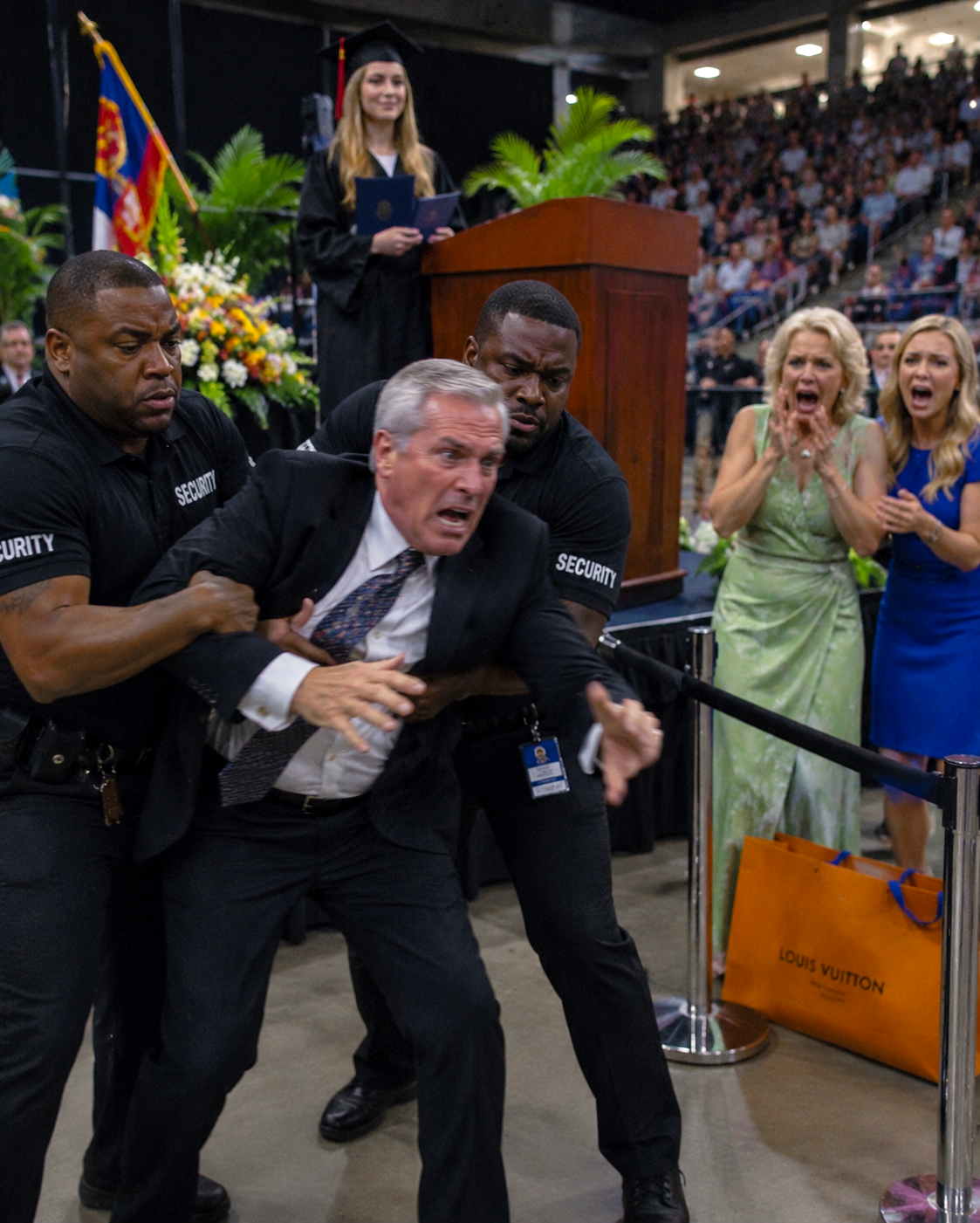
Richard stood so abruptly he knocked his knee into the row in front of him.
Then he started running.
“That’s my daughter!” he shouted as he pushed down the donor aisle.
“That’s my daughter!”
The lie of it nearly made Savannah laugh.
By the time she crossed the stage, campus security had already started moving toward him.
Richard slipped past one guard and made it to the edge of the platform.
He reached up toward her with a face rearranged into paternal pride so quickly it looked grotesque.
“Savannah,
baby, listen-”
She let him get just close enough to believe he could recover the moment.
Then she stepped to the microphone and said, clear and calm, “Remove these people.
They’re not with me.”
The silence after that was almost holy.
Security took Richard by the arm.
Cynthia called out Savannah’s name in a voice suddenly full of motherhood.
Tiffany sprang up and shouted that this was humiliating and insane.
The jumbotron caught every second of their faces while Savannah accepted her diploma and smiled for the official photo.
By sunset, the clip had gone viral.
By midnight, Savannah had more than seventy missed calls.
Richard texted that he was proud of her.
Cynthia said there had been a misunderstanding.
Tiffany sent a rambling message about family opportunities, image management, and how they could all win if Savannah stopped being emotional.
Savannah responded to none of it.
Three days later, her receptionist called the forty-second floor conference room to say her parents and sister had arrived without appointments.
Savannah told security to let them up.
Richard entered first, wearing the same confidence he had worn on the graduation stage.
Cynthia came in looking pale and breakable on purpose.
Tiffany wore white and brought a leather portfolio branded with her initials like she was already a founder instead of a girl with a social media following and an appetite for being funded.
Richard sat down, linked his hands, and got straight to the point.
“Tiffany needs five million dollars to scale her brand,” he said.
“You’ve had your moment.
Now it’s time to do something meaningful for your family.”
No apology.
No explanation for the interstate.
No mention of the group chat.
Savannah folded her hands in front of her.
“For what exactly?”
Tiffany brightened immediately.
“Luxury skin care, lifestyle verticals, high-end partnerships, maybe a podcast.
I already have the audience.
I just need the capital.”
“And why would I invest?”
Cynthia gave her a damp-eyed smile.
“Because we’re your family, Savannah.
Families help each other.”
Savannah almost admired the precision of the audacity.
“Fine,” she said.
“Let’s handle this like any other deal.
Full access to the family financials.
Every account, every liability, every business entity.
If I’m writing a check, I want to know exactly what I’m buying.”
Richard smiled at once.
He thought due diligence meant agreement.
He thought numbers would flatter him.
“Done,” he said.
He slid a folder across the table, and Tiffany emailed over additional statements from her laptop.
Savannah took them without a word.
She already knew something was wrong.
Richard worked in regional sales.
Cynthia had not held a job in over a decade.
Tiffany’s company, Maison Tiff, had no revenue.
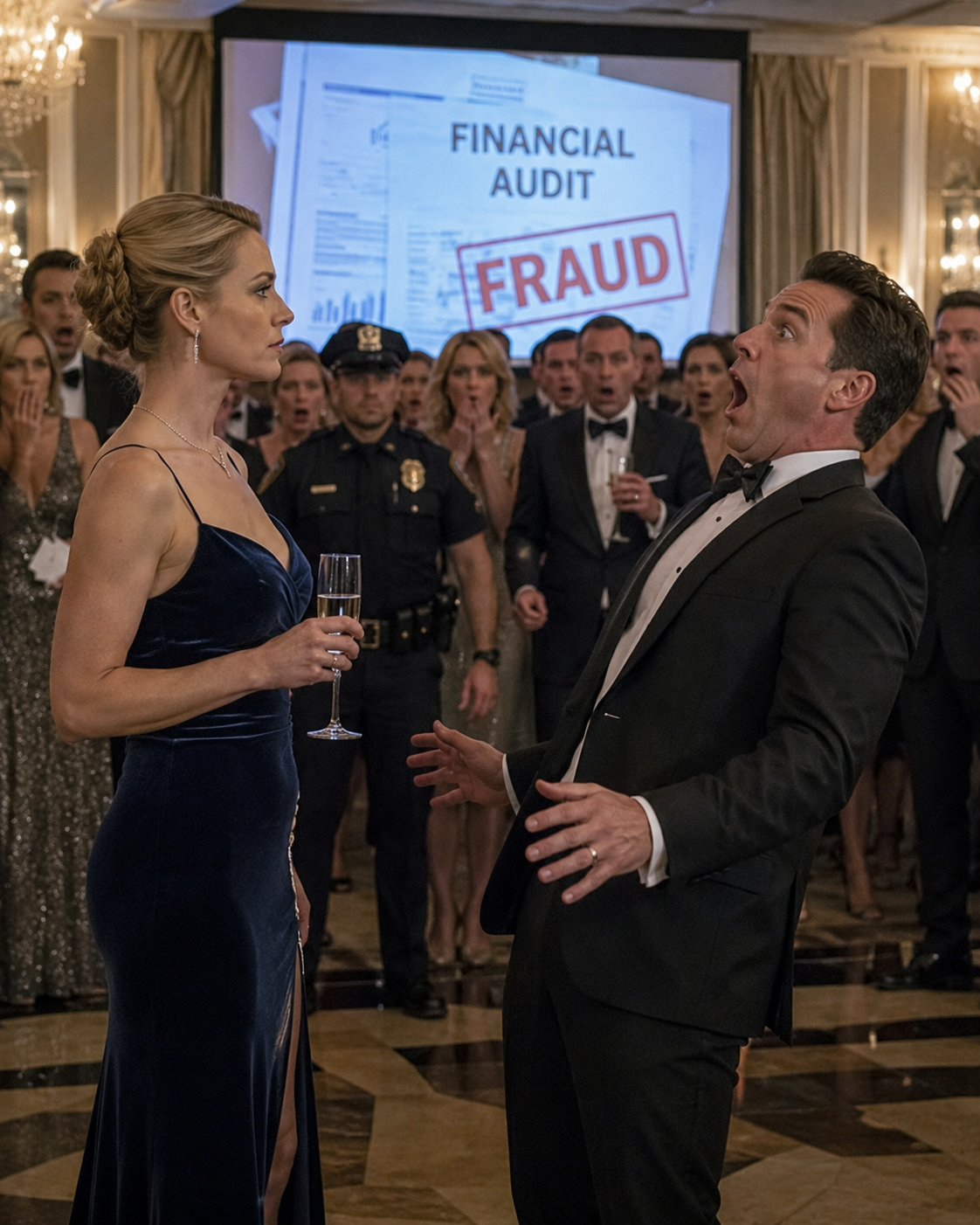
Yet they floated through the world in a Bentley, bought Hermès like flowers, and somehow landed donor seating at a university event whose price Savannah knew very well.
Savannah did not confront them immediately.
She excused herself, walked the file package straight to her chief financial officer, Mateo Alvarez, and called in her general counsel, Priya Shah.
Twenty-seven minutes later, the three of them were staring at a trust account Savannah had never known existed.
Eleanor Hart Education Trust.
Beneficiary: Savannah Reed.
Eleanor Hart, Savannah’s maternal grandmother, had died five years earlier.
She had been a sharp, formidable logistics entrepreneur who never
raised her voice and never missed what happened in a room.
Savannah remembered exactly one thing Eleanor had ever said to her in private: Learn the difference between people who clap when you rise and people who only clap when they can stand beside you in the photo.
The trust documents told the rest.
Eleanor had left Savannah a protected fund for education, housing, and business formation because, in Eleanor’s own words, she had concerns about “patterned emotional neglect within the household.” Richard and Cynthia had been named co-trustees until Savannah turned twenty-five.
The money was not for the family.
It was not for Tiffany.
It was solely for Savannah.
And it had been quietly drained.
Mateo pulled up the transaction history on the large monitor.
There it was.
A transfer to Brighton Motor Group for the Bentley deposit.
Monthly lease payments from the same account.
A charge to Hermès that matched the amount of Tiffany’s giant orange box.
The invoice for the donor section at graduation.
Twelve separate transfers to Maison Tiff LLC.
Mortgage supplements.
Travel.
Jewelry.
Consultants.
Advertising buys for a brand that did not exist.
Savannah’s face did not change.
Priya’s did.
“These withdrawals required dual authorization,” Priya said.
Mateo clicked deeper.
The first approval on each transfer belonged to Richard.
The second did not belong to Cynthia.
It belonged to Tiffany’s company login.
Savannah stared at the screen for a long second.
Then she said, very softly, “Bring them back in.”
When her family returned to the conference room, the monitor was already on.
Richard saw the account title first.
The blood left his face.
Cynthia stopped breathing for a second.
Tiffany recovered quickest, which was its own kind of confession.
“That was family money,” she said.
“Grandma left things for all of us.”
Savannah looked at her.
“No.
She left this for me.”
She tapped the screen, pulling up the trust language.
Sole beneficiary: Savannah Reed.
Then she pulled up the Bentley transfer.
“You bought the car with my trust.”
Richard straightened his shoulders.
“We managed it for you.
You weren’t using it.”
Savannah pulled up the Hermès charge.
“You bought that too.”
Then the donor section invoice.
“And those seats.”
Then the Maison Tiff transfers.
“And your brand, Tiffany.
Every consultant, every photo shoot, every fake launch strategy.”
Cynthia found her voice first.
“We were going to replace it.”
Mateo clicked open the authorization forms.
Savannah’s forged signature appeared again and again, attached to dates when she had been in Zurich for investors, in Boston for finals, and once in the hospital overnight after a stress-induced collapse her family had called dramatic.
Priya slid a second set of papers onto the table.
“There is also the matter of fraud, breach of fiduciary duty, and criminal exposure,” she said evenly.
“Especially now that we can show the beneficiary never consented.”
Tiffany’s mask cracked.
“You don’t need that money,” she snapped.
“You have a billion dollars.
Grandma always liked you better anyway.
Why do you care?”
Savannah looked at her sister for a long time.
“Because you laughed while spending it,” she said.
“Because Dad left me on the highway in a cap and gown so your gift box wouldn’t wrinkle.
Because Mom hearted your picture.
Because all of you used what was mine to convince
me I was the extra weight.
That’s why I care.”
Richard slammed his palm on the table.
“We raised you!” he barked.
“You think you got here alone?”
Savannah’s eyes never left his.
“You left me on the side of the interstate because a handbag box needed my seat.
Don’t ever confuse access with raising me.”
For the first time since entering the room, Cynthia started crying for real.
It changed nothing.
Priya informed them that emergency motions had already been filed to freeze the remaining trust assets, enjoin further transfers, and preserve digital records from Maison Tiff and every linked account.
Richard tried to stand and was immediately met by the head of building security at the door.
Tiffany shouted that Savannah was ruining her life.
Savannah answered without lifting her voice.
“No,” she said.
“I’m documenting yours.”
The consequences arrived faster than any of them expected.
The bank froze the accounts that same afternoon.
Brighton Motor Group repossessed the Bentley forty-eight hours later while Tiffany was live-streaming from the driveway.
The university foundation, after receiving proof that the donor-section payment had come from a misappropriated trust, returned the money directly back to the account and issued a statement clarifying that Richard and Cynthia Reed had never been recognized donors.
Maison Tiff collapsed before it launched.
The brand consultants withdrew.
The pending retail conversations disappeared.
Every glamorous expense that had made Tiffany look successful turned out to have been funded by money stolen from her sister.
Then came the lawsuit.
Savannah did not blink at the cost of fighting it.
She had more than enough money now, and for the first time in her life, she also had the power to choose not to absorb what was done to her in silence.
Priya filed civil claims for restitution, fraud, conversion, and breach of fiduciary duty.
The district attorney opened a parallel criminal investigation once the forged authorizations and routed transfers through Tiffany’s LLC were authenticated.
Six months later, the case ended in a way Savannah’s family had never imagined possible.
Richard pleaded guilty to felony fraud and fiduciary theft to avoid a longer trial.
Cynthia signed a settlement admitting unauthorized use of trust assets and agreed to permanent disqualification from any trustee role.
Tiffany, facing the digital approval logs that tied her company directly to the transfers, signed a consent judgment that forced the liquidation of every branded asset she had tried to build from Savannah’s money.
The house was sold.
The jewelry went to auction.
The remaining balances were clawed back with penalties.
When the dust settled, most of the trust had been restored, along with damages and legal fees.
More importantly, the lie that had held Savannah small all those years was gone.
Near the end of the case, Priya handed Savannah one final document found in Eleanor Hart’s original estate file.
It was a letter, folded into the scanned trust packet and never shown to her.
Savannah sat alone in her office and read it twice.
My dear girl,
If you are reading this, then time has already shown you who celebrates you and who only tolerates you while they believe you can be diminished.
This money is not a prize for suffering.
It is insulation.
I am leaving it to you because I do not
want your future negotiated by people who confuse your quiet with surrender.
Build something of your own.
Spend your life where you are not asked to shrink.
Savannah cried then, but only then.
A year later, she returned to campus, not as a graduate in borrowed calm, but as the founder of the Eleanor Hart Fellowship for students building companies without family support.
She funded tuition grants, emergency housing, and seed money for founders whose lives looked polished in public and unstable everywhere else.
At the ceremony, students lined up for photos with her.
Parents cried.
Cameras flashed.
Somewhere outside the stadium, buses hissed at the curb and carried people home who had no idea what kind of day they had just survived.
Savannah stood at the podium and did not mention the highway.
She did not mention the Bentley, or the orange box, or the group chat, or the way her father had suddenly found the word daughter only after the jumbotron made her valuable in public.
She simply looked out at the graduates and said, “There are people who will measure your worth by how useful you are to their image.
Let them be wrong from a distance.”
The applause lasted a long time.
Afterward, alone for a moment in the quiet hallway behind the stage, Savannah touched the edge of Eleanor’s letter where she kept a copy folded into her wallet.
The money had come back.
The truth had come out.
Justice, in the formal sense, had been done.
But even then she could not decide what the deepest wound had been.
Not the theft.
Not the forged signatures.
Not even the sight of the Bentley disappearing while she stood on the shoulder in cap and gown.
It was the simpler thing.
The colder thing.
How easily they had laughed while spending what was already hers.
And whether the biggest red flag in a family was the cruelty you could see-or the smile people wore while calling it love.