The bill that lawmakers once called “long overdue” finally made its way through the House — and it wasn’t just a win; it was a landslide. With an overwhelming 409–2 vote, the Take It Down Act cleared one of the biggest hurdles in Congress, marking a rare moment of near-unanimous agreement in a political era defined by constant division.
But for the people who have been targeted, humiliated, and psychologically wrecked by deepfake sexual imagery, the bill wasn’t simply legislation. It was vindication.
The Take It Down Act directly criminalizes the creation, distribution, or possession of AI-generated nonconsensual sexual content. In simpler terms: deepfake porn targeting real people — celebrities, private citizens, minors, spouses, coworkers, anyone — is now legally recognized as what it is: exploitation. And the people behind it can finally be held accountable.
For years, victims of this technology had almost no recourse. Someone could take an innocent photo from Instagram, TikTok, or even a LinkedIn headshot, run it through an AI generator, and create sexually explicit content convincing enough to destroy a reputation. That content could then be posted on adult sites, shared in group chats, emailed to employers, or thrown around anonymously on social media. Victims were told to “just report it,” but the platforms ignored takedown requests, hid behind legal gray zones, or moved too slowly to prevent the damage.
The emotional toll was real. Careers ended. Relationships collapsed. Teenagers attempted suicide. Women were disproportionately targeted, but no one was safe. The internet had evolved — the law hadn’t caught up.
That gap is exactly what the Take It Down Act aims to close.
The bill requires online platforms — from major social networks to adult websites — to remove reported deepfake sexual content within 72 hours. No excuses, no “pending review,” no endless loops of automated emails. If a victim flags it, the platform has three days to take it down or face penalties. And for the first time, victims can sue not just the creators of the content, but also the companies that refuse to remove it.
The act also reclassifies the creation of deepfake sexual imagery as a federal crime. Offenders can now face significant financial penalties and even jail time. Lawmakers made it clear: digital manipulation is not a loophole. A deepfake is not “just an image.” It is a weapon.
What surprised many observers wasn’t the bill itself — proposals like this have floated around Congress for years — but the level of bipartisan support. In an age where lawmakers can’t agree on lunch orders, this was different. Members from both parties, across multiple committees, rallied behind it.
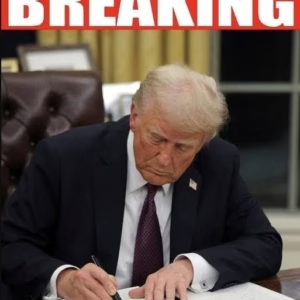
President Trump endorsed the act early, framing it as a defense of personal dignity in an era where technology can be used to destroy a person’s life overnight. That endorsement helped push hesitant members over the line and turned the bill into a priority vote.
Supporters argue that the act does more than penalize wrongdoing — it restores something fundamental: consent. Deepfake abuse strips people of that. It steals control of their own bodies, their own likeness, their identity. And in the digital world, once the damage spreads, it can’t fully be undone. But it can be stopped from getting worse.
The bill’s passage sparked immediate reaction online. Activists who’d spent years advocating for digital privacy celebrated. Survivors shared their stories publicly, many for the first time, saying the vote finally made them feel seen. Parents expressed relief that their children might be safer in a world where images circulate faster than common sense.
Tech experts acknowledged the act won’t magically halt the spread of deepfakes — the technology is advancing too quickly — but agreed it sets a crucial precedent. It signals that the law is no longer willing to let innovation outpace morality.
Behind the scenes, platforms are scrambling to prepare. Some are developing faster detection systems. Others are rewriting their moderation rules. A few are panicking, worried about the fines they’ll face if their systems fail to meet the 72-hour deadline. And a handful are quietly lobbying for more time, hinting that the challenge is bigger than Congress realizes.
But for victims, the timeline isn’t negotiable. Three days of exposure can ruin a life. One hour can go viral. That’s why the bill’s drafters refused to make the window any larger.
As the legislation moves to the Senate, momentum is on its side. The public wants action. The courts want clarity. Even tech companies — the ones that once hid behind vague policies — now say they’d rather have firm rules than navigate a moral minefield alone.
For decades, the internet has evolved without guardrails, leaving too many people defenseless in the face of tools that can replicate a person’s face, voice, or body with terrifying accuracy. The Take It Down Act doesn’t solve every problem tied to deepfakes, but it draws a line in the sand: consent isn’t optional just because technology makes violation easier.
And maybe that’s why the vote was so lopsided. No political party wants to be remembered as the one that sided with predators.
If the Senate passes the act — which analysts now consider likely — it will head to the President’s desk. And the moment it’s signed, the digital landscape shifts. Victims gain power. Platforms gain responsibility. Offenders lose their anonymity.
In a world where people fear being cloned online more than being followed down a street, that shift matters.
For the first time in a long time, Congress didn’t just acknowledge the danger. It acted. And that alone makes this moment historic.