Kathy Bates has long been recognized as one of the most formidable actresses of her generation, known for emotional precision, authority on screen, and a rare willingness to inhabit difficult roles without compromise. Her career reflects strength in many forms—but behind the accolades exists a quieter story, shaped not by performance, but by endurance.
Long before she became an advocate for cancer survivors and people living with chronic conditions, Bates was navigating a private medical reality that tested her in ways no role ever could. Her journey is not one of spectacle or inspirational slogans. It is a human account, marked by fear, uncertainty, deliberate choices, and persistence when ease was unavailable.
A Silent Diagnosis
In 2003, at the height of her career, Bates was diagnosed with ovarian cancer—a disease often called “silent” because its early symptoms are vague and easily missed. Like many women, she learned of her illness only after it had progressed enough to require immediate and aggressive treatment.
She chose privacy. Only a small circle knew what she was facing. Later, Bates explained that she did not want her work overshadowed by illness, nor did she want to be defined by vulnerability. Her focus was direct and practical: survival.
Treatment involved major surgery followed by roughly nine months of chemotherapy. The toll was significant—physically and emotionally. Yet when possible, she continued working, holding onto routine and purpose amid instability.
Remission—and Return
After treatment, Bates entered remission and lived cancer-free for nearly a decade. She spoke little about what she had endured. Recovery, for her, was personal rather than performative.
In 2012, she publicly acknowledged her ovarian cancer for the first time, sharing—without drama—that she had been in remission for nine years. There was no celebration, only relief. She believed that chapter had closed.
It had not.
Only weeks later, Bates was diagnosed with breast cancer. Despite her prior experience, the news was devastating—perhaps more so because it arrived after years of believing the worst was behind her. With a family history of the disease, the risk was known, but awareness does not soften the moment of diagnosis.
A Decisive Choice
Bates chose to undergo a double mastectomy. The decision was not rooted in panic, but in long-term thinking. Given her history, she prioritized reducing future risk over preserving appearance. The surgery was successful, and she again emerged cancer-free.
Throughout this period, she retained her characteristic perspective and humor—not as denial, but as agency. Humor became a way of asserting control where control was limited.
Life After Treatment
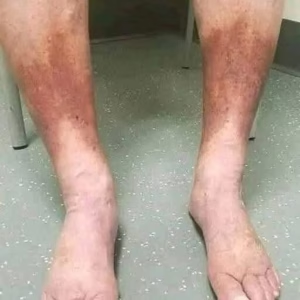
Cancer, however, left a lasting imprint. During surgery, lymph nodes were removed, leading Bates to develop lymphedema—a chronic condition involving swelling, pain, and restricted mobility. It has no cure and requires lifelong management.
For Bates, this became a daily reality. Ordinary tasks demanded planning. Discomfort was constant. Survival, she learned, does not always mean returning to who you were before.
From Privacy to Advocacy
This time, she chose to speak. Recognizing how unprepared many survivors are for life after treatment, Bates began advocating for awareness around lymphedema and lymphatic diseases. Her focus was practical: education, early diagnosis, and research.
Her message was steady and unsentimental. Survivorship is not an endpoint—it is a new phase, often with invisible challenges. Beating cancer is only part of the journey.
She also emphasized preventive care: routine screenings, understanding family history, and responding early to symptoms. Her intent was not fear, but responsibility. Early detection, she has said plainly, saved her life.
A Strength Without Romance
What gives Kathy Bates’s story its weight is its realism. There is no attempt to frame illness as a gift or suffering as transformation. There is no heroic narrative—only informed decisions, persistence, and refusal to give up.
She has never presented herself as extraordinary. Only as someone who continued because stopping was not an option.
A Legacy Beyond Performance
Today, Kathy Bates’s legacy extends beyond acting. She represents a form of strength rooted in truth rather than image—strength that includes scars, chronic conditions, and the courage to speak openly when silence would be easier.
Cancer tried twice to define her life. Twice, she declined.
Her story reminds us that survival is not merely about longevity. It is about living honestly, making informed choices, and continuing forward with clarity and purpose—even when the path is altered.